How One Family Turned a 15-Day Europe Trip into a Collaborative Travel Journal
Summary Emma and James Whitfield spent 15 days travelling through France, Switzerland, and Italy with their two children. They came home with 1,247 photos across four phones, a stack of train tickets, and one shared goal: not letting the trip dissolve into a forgotten camera roll. This is the story of how they used a family travel scrapbook to combine Emma's daily journal entries with everyone's photos — and what other travelling families can take from the way they did it.
The Trip That Started It All
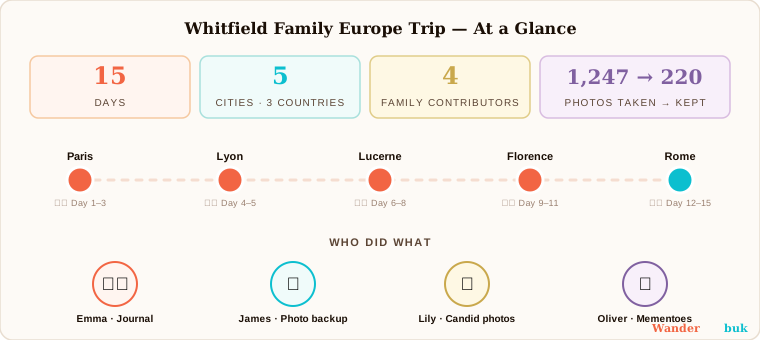
Most families come home from big trips with too many photos and no plan for what to do with them. The Whitfields — Emma, James, ten-year-old Lily, and seven-year-old Oliver — flew from Melbourne to Paris in April 2026 for a long-promised "big Europe trip." Fifteen days, five cities, three countries, four travellers. By day three they had already taken more photos than they had in the previous six months combined.
"On our last family holiday, we came home with nine hundred photos and made nothing with them," Emma says. "Six months later I couldn't remember which town we ate that pasta in. I didn't want this trip to disappear the same way."
She had read about collaborative photo books before they left and floated the idea over kitchen-table planning. James was sceptical at first — another app, another login. The thing that won him over was the journal idea. Emma had kept a small notebook on every trip since university and wanted a way to combine her writing with the photos everyone else was taking. That meant they didn't just need a photo book — they needed a digital scrapbook that could hold journal entries too.
1. Planning the Book Before the First Flight
The most important thing the family did was decide on the structure of the scrapbook before they left, not after. Fifteen minutes around the kitchen table in Melbourne saved hours of organising later.
The plan covered three decisions:
- Step 1 — Define the chapters. One chapter per city: Paris, Lyon, Lucerne, Florence, Rome. Two or three spreads per chapter.
- Step 2 — Assign roles. Each family member had a clear job. Emma kept the daily journal. James backed up every photo from every phone to one shared folder. Lily, the family's amateur photographer, took the candid shots her parents would miss. Oliver was put in charge of physical mementoes — train tickets, museum stubs, gelato wrappers — which James photographed each evening.
- Step 3 — Pick the tool. They chose Wanderbuk because it allowed multiple contributors without giving everyone full editing rights, and because they could export the finished book to a print-ready PDF for free.
"Honestly, giving the kids a job changed how they engaged with the trip," James says. "Oliver started asking for tickets at every train station because they were his job. Lily looked at scenery completely differently because she was thinking about the photo first."
2. Why a Journal Plus Photo Book Beats Either Alone
A travel scrapbook works best when it combines what you saw with how it felt. Emma had always known this from her notebooks, but seeing it laid out as full spreads made the difference obvious.
"A photo of the Eiffel Tower tells you we were there," she says. "What it doesn't tell you is that Lily was furious because we made her wait an hour in the queue, and then she gasped when we got to the top because she'd never seen a city that big from the air. That moment is gone if I don't write it down."
This is the part most digital scrapbooking guides skip. Photos capture what something looked like. Journals capture what it felt like. A travel scrapbook that combines both is the only kind you'll actually want to reread in ten years. For more on why context matters in a travel book, our travel photo album guide covers it in detail.
3. Inviting the Whole Family as Contributors
The single biggest unlock for the Whitfields was contributor-level access — letting everyone add photos and notes without giving anyone the ability to break the layout. Emma set herself as the book's owner and added James, Lily (under her supervised account), and Oliver as contributors.
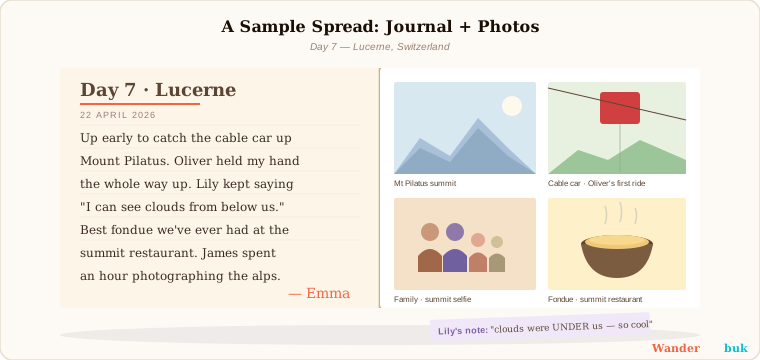
The collaboration unlocked photos Emma would have missed entirely. Lily uploaded a sequence of pigeons taking off in Piazza San Marco that became one of Emma's favourite spreads. James contributed the panoramic shots Emma hadn't taken because she'd been holding Oliver's hand on the cable car up Mount Pilatus. Oliver's ticket-stub photos turned into a four-page chapter intro section that none of them had planned.
"I was honestly worried it would feel like extra work," James says. "It was the opposite. The kids would upload their favourite photos from the day on the train ride to the next city, and I'd just check in on what they'd added. It became a small family ritual we all looked forward to."
4. Building the Spreads: Photos Anchored by Journal Entries
Each spread in the finished book follows a simple pattern. The left page holds Emma's short journal entry, written in a script-style font that mimics handwriting. The right page holds three or four photos from that day — usually a hero image, a candid from Lily, and a closeup of a meal or a memento. A small caption under each photo notes the place and one detail worth remembering.
"I love that the pages don't all look identical," Emma says. "Some spreads have just one big photo because that's the only one that mattered. Others have eight because we couldn't choose. Mixing layouts on the same project — that's the thing I didn't know I wanted until I had it."
By day six, Lily had started writing her own short journal entries too. They went into a "Lily's notes" sidebar on the right-hand page — a small grey box with her name on it. By the end of the trip, she had contributed to fourteen of the seventy-six pages.
5. The Final Result and What Surprised Them Most
Three weeks after they got home, the book was finished — 76 pages, 15 chapters, 220 photos selected from the 1,247 the family took. Emma exported a high-resolution PDF and ordered four printed copies: one for the family, one each for the two sets of grandparents, and one as a thank-you for the friend in Florence who had hosted them for two nights.
What surprised her most was how often the kids opened the book afterwards.
"They flip through it constantly. Oliver keeps asking about the day we got lost in Lyon. Lily showed it to her whole class at school. We've had it three months now and the corners are already getting soft."
James adds, "If I'd known how easy it was to set up, we'd have done one for the trip we took to New Zealand two years ago. Those photos are still sitting on a hard drive."
What This Approach Means for Any Travelling Family
The Whitfields' system isn't unusual or complicated. What was different was the structure they put in place before the trip — assigning roles, agreeing on chapters, and choosing a tool that supported all of it without getting in the way.
A few lessons worth taking from their experience:
- Decide the shape of the book before you leave. Chapters by city or by week make every photo and note feel like it has a place to go.
- Give every family member a role. Even small kids engage differently when they have a clear job.
- Combine writing with photos. Two minutes of journalling each evening becomes ten years of payoff.
- Keep editorial control with one person. Collaboration should mean shared input, not shared layout decisions.
If you're planning a family trip or you've just come home from one, you can start your free family scrapbook on Wanderbuk and invite everyone before the holiday photos disappear into the camera roll. For the full collaborative workflow, see our collaborative photo book guide; for the photo-organisation side, our travel photo album guide covers layout and curation in more depth.
The Whitfields' book is one trip. Their next trip — Japan, this December — is already planned, with a fresh Wanderbuk project ready before they even board the plane.
Related reading: What Is a Digital Scrapbook? — Travel Photo Album & Trip Photo Book Guide — Best Online Scrapbook Makers — Collaborative Photo Book Guide