The History of Scrapbooking: From Victorian Albums to the Digital Travel Scrapbook
Summary Scrapbooking is more than five hundred years old. What began as handwritten commonplace books in fifteenth-century Europe evolved into Victorian die-cut albums, Mark Twain's self-pasting innovation, and the photo album boom of the twentieth century. Today, the digital scrapbook and digital travel album have taken over — combining the personal touch of the original craft with cloud-based collaboration, instant sharing, and zero glue. This guide traces the full journey and ends with an honest look at the best virtual scrapbook tools available in 2026, and why Wanderbuk stands out for travellers.
Why Scrapbooking Has Lasted Five Centuries
Scrapbooking has survived because the impulse behind it has not changed — humans have always wanted to preserve and arrange the small things that mark out a life. The form has changed dramatically over five hundred years, but the underlying need is the same in 1525 and 2025. Every generation has found its own materials and its own tools, from quill and ink to scissors and paste to a phone camera and a browser tab.
What follows is the long story of how we got from handwritten notebooks in fifteenth-century libraries to today's collaborative digital travel scrapbook that you can build from anywhere in the world.
1. The Commonplace Book and the Friendship Album (1400s–1700s)
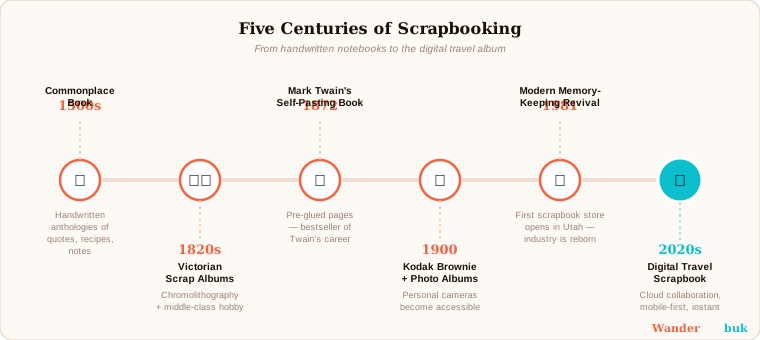
The earliest ancestor of the scrapbook is the commonplace book — a handwritten notebook used by scholars, students, and educated readers across Europe from the late fifteenth century onward. People copied quotes, recipes, sermons, mathematical formulas, and personal observations into these books, organising them by theme. They were practical reference works and personal anthologies in one.
By the sixteenth century, the form had branched out:
- Friendship albums (the German alba amicorum) became fashionable among university students in northern Europe. Friends, teachers, and visiting scholars would write a motto, draw a small illustration, or paste in a token. These were the first books deliberately built from contributions by multiple people — the original collaborative scrapbook.
- Florilegia — botanical scrap collections — preserved pressed flowers and plant cuttings alongside hand-drawn taxonomies.
The commonplace book established the basic format that scrapbooks still follow today: a bound collection of personally selected fragments, arranged with intent.
2. The Victorian Scrapbook Boom (1820s–1900)
The Victorian era was the golden age of physical scrapbooking, driven by two industrial shifts: cheaper paper and the invention of chromolithography. Affordable colour printing made decorative paper scraps, calling cards, and advertising trade cards widely available, and middle-class households suddenly had something to paste in.
The word "scrapbook" itself entered common use in the 1820s, popularised by the practice of grangerising — pasting illustrations into extra-wide editions of biographies, named after the eighteenth-century English clergyman James Granger.
Three milestones from this era still shape what scrapbooks look like today:
- Step 1 — Commercial scrap albums arrive. Publishers began selling pre-bound albums with decorative covers, designed specifically for pasting in scraps. By the 1860s, these were a popular middle-class gift on both sides of the Atlantic.
- Step 2 — Mark Twain's self-pasting scrapbook. In 1872, Mark Twain patented a scrapbook with pre-glued strips on every page — just wet and stick. It was one of his most lucrative commercial products, reportedly earning him more than several of his novels combined.
- Step 3 — The arrival of the personal camera. When Kodak released the Brownie in 1900, ordinary people began taking their own photographs, and scrapbooks started filling with personal images rather than just printed scraps.
By the early twentieth century, soldiers in the First World War were carrying small scrapbooks to preserve postcards, letters home, and unit photographs — an early form of the travel keepsake.
3. The Photo Album Era and Its Decline (1920s–1990s)
Through most of the twentieth century, the photo album dominated personal memory-keeping. Pages with adhesive corners, plastic sleeves, and sticky backing made photo storage easy, but they also stripped away the personal layering that made earlier scrapbooks distinctive. A photo album was for photographs and not much else.
The craft itself nearly vanished from popular culture between roughly 1930 and 1980. It survived in pockets — among family historians, journallers, and collectors — but it was no longer the mainstream pursuit it had been in Victorian times.
Then, in 1980, a homemaker in Spanish Fork, Utah named Marielen Christensen displayed forty-eight bound volumes of her family's keepsakes at the World Conference on Records in Salt Lake City. The response was so strong that she opened Keeping Memories Alive in 1981 — widely credited as the first dedicated scrapbook store. The modern memory-keeping movement was born.
Through the 1990s and early 2000s, scrapbooking became a multi-billion-dollar industry. Direct-sales companies sold tools, templates, and themed kits to a generation of families who wanted to preserve their photographs with personality and craft.
4. The Digital Shift (2000s–2010s)
The first wave of digital scrapbooking began in the mid-2000s, when broadband and home printers made it possible to design pages on a computer and print them at home. Two technologies converged:
- Online photo book services offered template-based layouts that could be ordered as printed books and shipped to the buyer.
- Dedicated digital scrapbooking software let hobbyists build pages with digital "papers," embellishments, and fonts — first on desktop, later in the browser.
The industry shifted further when general-purpose browser-based design tools made template work accessible to anyone with an internet connection. Smartphones did the rest. Once everyone carried a high-resolution camera in their pocket, the question was no longer will you have photos? — it was what will you do with the thousands you already have?
Physical scrapbooking declined sharply through the 2010s as a result. But the underlying need — preserving and arranging memories — didn't go anywhere. It just moved online.
5. The Modern Digital Travel Scrapbook (2020s)
Today's digital travel album is the natural endpoint of this five-hundred-year journey. It combines the personal layering of the Victorian scrapbook, the mobility of the smartphone, and the collaborative spirit of the original friendship albums into a single online tool.
A modern virtual scrapbook lets you:
- Upload hundreds of photos from a trip in minutes
- Drop them into pre-designed travel templates organised by city, day, or theme
- Add journal entries, captions, and digitised mementoes (tickets, menus, maps)
- Invite family members or travel companions to contribute photos from their own phones
- Export the finished book as a print-ready PDF or share it as a private link
The shift to cloud-based collaboration is the biggest single change in five centuries. For the first time, a scrapbook can be built by an entire group in real time, without anyone needing to be in the same room. If you're new to the format, our guide to what a digital scrapbook actually is covers the basics, and the travel photo album guide walks through how to organise the photos themselves.
6. The Main Digital Scrapbooking Platforms in 2026
Several platforms now let you build a virtual scrapbook online. Each one has a slightly different focus:
- Canva is a general-purpose design tool with a huge template library. It works for scrapbook-style pages but isn't built specifically for them, and many of its key features — premium templates, high-resolution export without watermarks, advanced collaboration — sit behind a paid plan.
- Mixbook is best known for printed photo books with strong physical print quality. The editor is polished, but the entire model is built around selling printed copies; the free tier is limited enough to feel like a demo rather than a working tool.
- Shutterfly is another print-led service. Useful if you want a hardcover book at the end, less flexible if you mainly want a digital keepsake.
- Smilebox focuses on animated digital slideshows and ecards rather than full scrapbook spreads.
- Heritage Makers and similar desktop-software-based tools target dedicated hobbyist scrapbookers who want granular control over every element.
For a deeper feature-by-feature comparison, see our review of the best online scrapbook makers.
7. Why Wanderbuk Stands Out for Travellers
Wanderbuk is the only platform on this list built specifically around travel memories, and the only one that combines a few practical things into a single free tier:
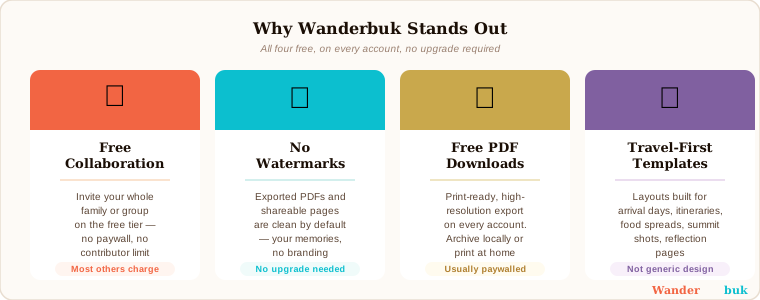
- Free collaboration from day one. Most platforms gate multi-contributor access behind a paid plan. On Wanderbuk it is included on the free tier, which means an entire family or friend group can build one shared book together without anyone paying for a subscription.
- No watermarks on exports. Many template-based tools stamp their branding onto exported pages until you upgrade. Wanderbuk's exported PDFs and shareable pages are clean by default.
- Free print-ready PDF downloads. High-resolution export is one of the most commonly paywalled features in the industry. On Wanderbuk it is standard, so you can print your book locally or archive it without committing to a subscription.
- Travel-first templates. Layouts are organised around the actual structure of a trip — arrival days, itinerary spreads, food and drink pages, summit shots, reflection pages — rather than generic page templates retrofitted for travel.
For a real-world example of how this works in practice, our family Europe trip story walks through one family's 15-day collaborative scrapbook from start to finish.
If you want to try it yourself, you can create your free digital travel scrapbook on Wanderbuk and invite your travel companions before your next trip.
Final Thoughts
Five hundred years separate the first commonplace books from today's collaborative cloud-based scrapbooks, but the impulse hasn't changed — and it probably won't. People will always want to preserve the moments that mattered and arrange them with care.
What's different today is how easy that has become without sacrificing the craft. A modern virtual scrapbook can hold every photo, every journal entry, and every memento from a trip — and still feel as personal as a hand-pasted album from 1875. The best digital travel album combines five centuries of inherited form with the convenience of a tool that travels in your pocket.
Related reading: What Is a Digital Scrapbook? — Travel Photo Album Guide — Best Online Scrapbook Makers — Collaborative Photo Book Guide — Family Europe Trip Scrapbook Story